Guitar for beginners and beyond, free lessons, tons of content.  
CLICK HERE to have a listen to some of my music.


Playing the guitar
Strumming
Finger picking
Hammer ons
Pull offs
Harmonics
Vibrato
Bending
Sliding
Muting
Slide guitar
Reading tablature


Plectrums come in different sizes and thicknesses. Tortoise shell was the traditional material but most are made of plastic nowadays. I know one great jazz player in Australia who uses wooden picks, apparently like the famous Django Reinhardt used to play with.

One of the best ways to practice strumming and keeping time, is to play along to records of music you like. Try to get into the habit early though of knowing what you're playing -- try to put a name to that chord you've just learned by ear. It will make it easier to fit the pieces of the puzzle together later on when you've got a collection.

It's easier than you think. Root notes are pretty easy to hear (listen to the bass note) and usually, but not always, are the I of the chord, so if the root is G, you can be pretty sure the chord will be a G chord. The quality, whether major, minor, seventh whatever, can then be looked into.


Strumming / Rhythm guitar

Most beginners decide to play with a flat pick, or plectrum. It's the easiest way to get a clear, loud sound out of guitar, especially on steel strings. Nylons aren't as suited to playing with a pick and prefer to be plucked by the fingers.

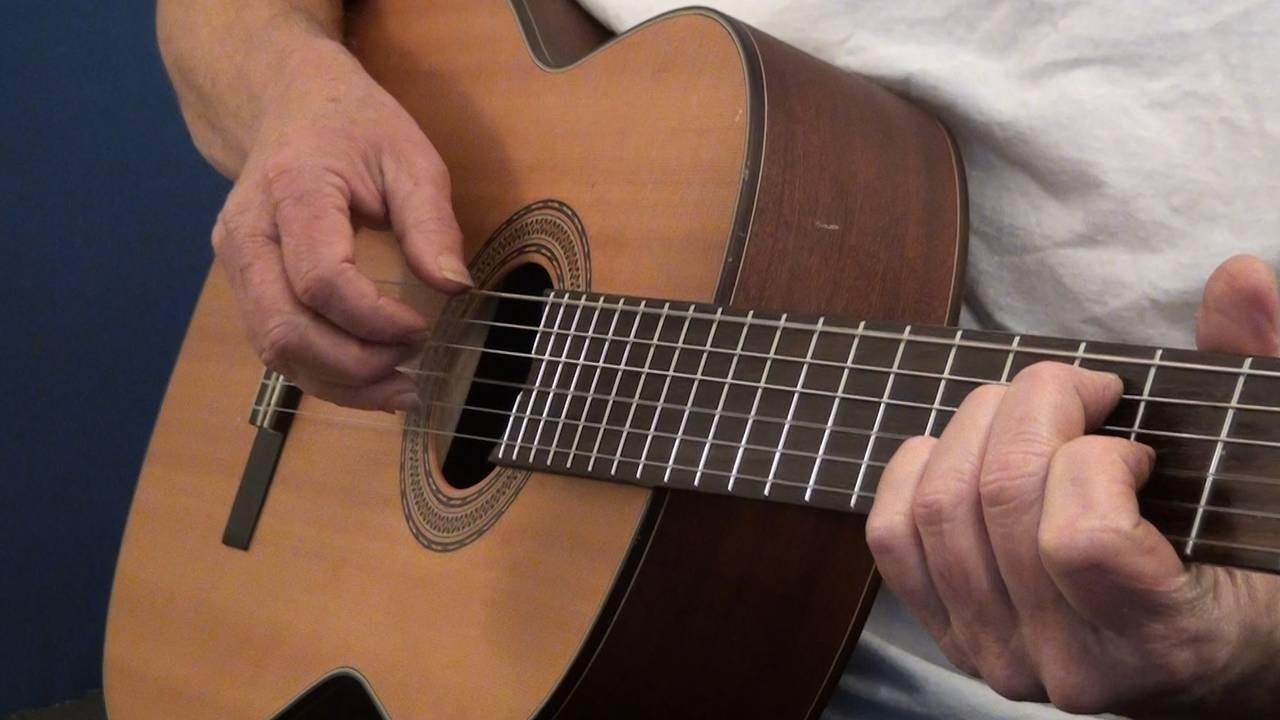
I have always been a finger style player and I never use a pick. I find them difficult to control, but only because I never use them. I tried for a while to use finger-picks, which slip on the ends of the fingers, but they also were uncomfortable for me.

The term "rhythm guitar" is often used. This describes a style of playing where you become half guitarist half percussionist. You can use you plectrum to either pick single notes or strum all six, or combinations of both. A common way of playing rhythm is to pick the root note of the chord and then strum the rest of the chord.

Like this.

 G

 Em7

 C+9  

 C+9  

 (Repeat)

Which looks like this on the fretboard. The root notes are slightly larger and the Em root note is the open bass E string. I've added a D note (third fret, B string) which appears in all the chords. The G remains a G, the Em becomes an Em7 and the C has become a major nine chord. I did this just because it sounds more interesting.


Here it is animated

And here is one way of playing it. I'm playing the root note of G on beat 1, then strumming beats 2 and 4, same pattern on the Em7, the same pattern for the Cmaj9 but not playing the root note on the second bar. I'm also adding in a couple of up-strokes to kick into the next bar. There are as many patterns and variations as there are snowflake designs.

Here is a 3/4 time version.

As for technique, I'll leave it up to you. Obviously there are downstrokes and upstrokes, you can "mute" the strings with the fleshy side of your hand to get a percussive sound -- a zillion ways of getting those strings a vibratin'. If you do have a yearning to make music, you should just experiment and mentally file the results. This goes on forever by the way. In fact, the more you know, the more music becomes one big experiment -- even during concerts or recording sessions.

There are a few players out there who can flat pick and finger pick really well, but not many. Most players gravitate towards one or the other as their 'standard' mode. I chose my fingers.

On to fingerpicking

Guitar Departments - guitar packages - guitar pickups - amps - effects - electric guitars - acoustic guitars - acoustic electrics - guitar tuners - beginners guitars - guitar cases - gigbags - tuners - guitar strings - Guitar Store

Copyright © 1998-2007 Kirk Lorange, all rights reserved. Reproduction in whole or in part in any
form or medium without the expressed written permission of K-Sharp Publishing is prohibited. | Contact - privacy agreement