Guitar for beginners and beyond free guitar lessons
CLICK HERE to have a listen to some of my music.


Playing the guitar
Strumming
Finger picking
Hammer ons
Pull offs
Harmonics
Vibrato
Bending
Sliding
Muting
Slide guitar
Reading tablature


Playing the guitar

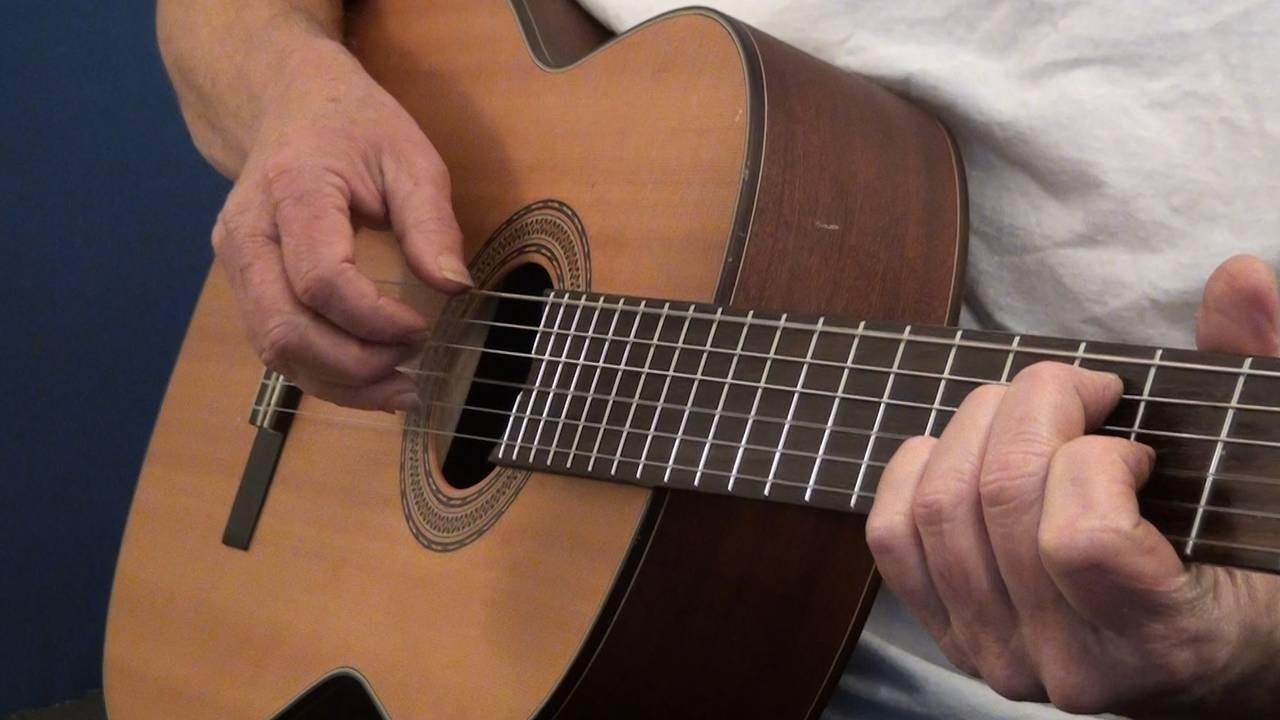
Once you know a little bit about how music is structured and where to find it on the fretboard, you must get those strings vibrating to make music. This, of course, means coordinating both hands. The fretboard hand must be holding the strings down firmly to allow the them to vibrate, and the picking hand must attack the strings cleanly also, to prevent unwanted notes from clouding the sound. This may take a little while to achieve, and practice is the only way to get there. Your finger tips will hurt like hell for a little while, as your callouses build up, and soon enough you won't feel any discomfort. Make sure you play at least a little each day to maintain their insensitivity.

The fretboard hand will also need some time to feel comfortable with some of the chord shapes, some of which require spreading the fingers out quite a bit, and changing from one chord to another seems impossible when you first start playing. Don't be discouraged, practice will make perfect.

To get the best leverage, power and control over the fretboard hand, try to make it a habit early on to keep the thumb as close to the middle of the back of the neck as possible. It should line up with your index finger, as if you're taking the neck's pulse. It's a firm but relaxed pressure. You'll find if you keep the thumb and index finger lined up, the other three fingers will be able to work independently. As your hand moves, this thumb/index combo moves with it. Your elbow should be dropped, everything should be relaxed. It's very easy for the shoulders to tense up ... try your best to keep everything relaxed and to make it habit.

Strings can be manipulated in countless ways to extract the music: they can be pushed sideways to 'bend' notes up in pitch; they can be 'hammered on' to get from one note to another; they can be 'pulled off' to get from one note to another; they can be muted to muffle the ringing; they can be slid up or down, to get from one note to another; they can be be wobbled back and forth to make the note wobble in pitch, a technique called 'vibrato'; they can be slid upon using a metal tube, known as 'slide guitar' (my speciality); they can be lightly touched at specific points to create 'harmonics' ... the list goes on. All of these together create a player's distictive trademark 'sound' that makes us instantly recognize them. They all come with time and eventually become second nature.

Let's check out some simple strumming

Copyright © 1998-2010 Kirk Lorange, all rights reserved. Reproduction in whole or in part in any
form or medium without the expressed written permission of K-Sharp Publishing is prohibited. | Contact - privacy agreement