Like this lesson? The downloadable version includes extra files, making it much easier to learn.
More details here
|
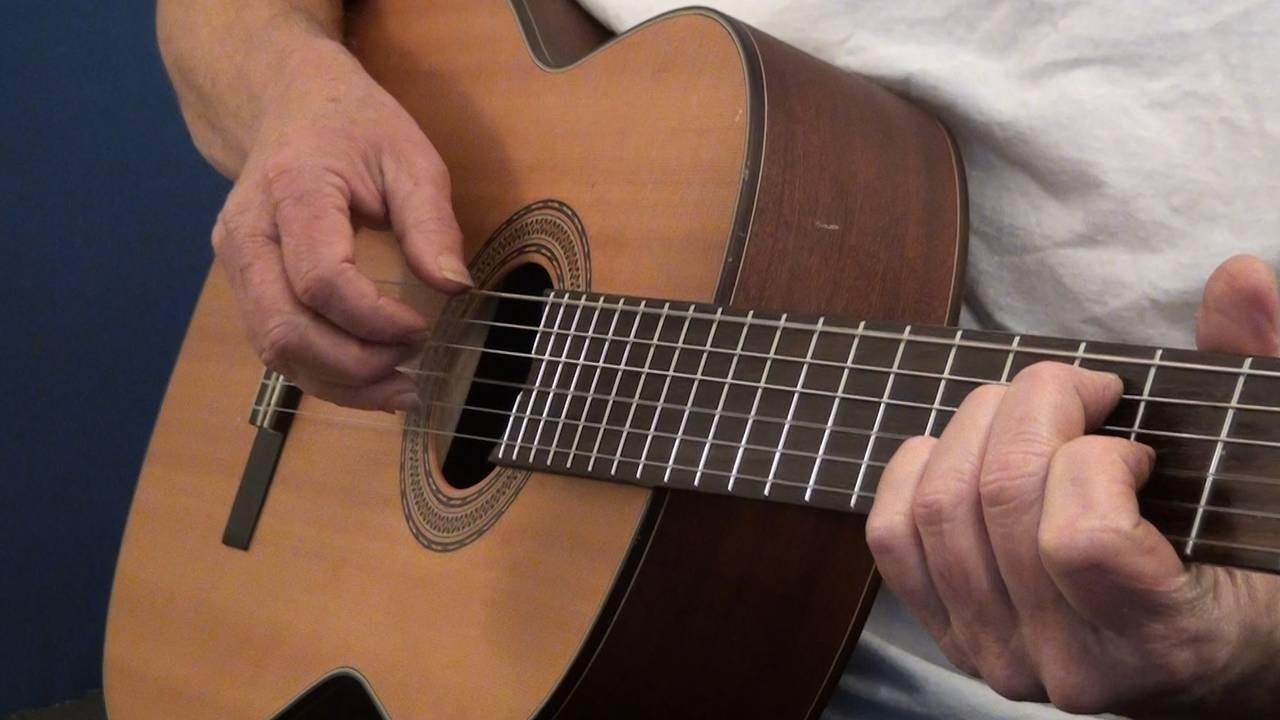
Refresh the page to watch the movie again. The movie or movies in the paid downloadable versions are high resolution and come in Windows Media Video format with all the Start-Stop-Pause buttons. Click on the movie to find out what you'll get when you buy this lesson. |
Mastered
the easy version? Then here is the 'tricky' version. It doesn't really seem like much looking at the tab ... it's really just a series of double stops, but getting those fingers around them takes a while to lock in, or at least it did for me.
I came up with this arrangement after listening to a few versions online. I wanted to capture that JS Bach feel. He was master at weaving melody and bass lines together like this. I'm fairly pleased with the result. I simplified it a bit from previous versions where I found my fingers getting all tangled up in knots with a third line appearing from time to time. I thought 'why make it impossible?' so I pared it back.
You'll notice for once there are no chord names in this. They'd be changing with every beat most of the time and wouldn't really be of benefit.
This version is the same melody line as the easy version, but instead of just a few roots appearing as bass notes, the bass line is a continuous harmony line to the melody. But, it's not a parallel harmony, rising and falling with the melody, it's non-parallel ... a separate melody. I believe you'd call it 'counterpoint' melody. Counterpoint usually involves the rhythm also, so I may well be corrected on this. Whatever it's called, it's a nice effect and really makes it sound like it should be played on a Lute a few centuries ago.
This one really does need to taken a few beats at a time. I found many of the moves very difficult to lock in. My fingers seemed to think that this was just not meant to be, I had to convince them many times that it was indeed what I wanted them to do. I found that I needed to just play the bass line a couple of times on its own to remind myself of what was going on.
You'll hear that some of the time, I'm not playing the double stops (the whole thing is a series of doubles stops) in unison ... the bass note and melody note are not in perfect sync, they're out by a nanosecond or two. I did this on purpose because it sounded (to my ear, anyway) more like an old fashioned Elizabethan rendition. At first I echoed this in the animated fretboard (for those who bought the downloadable lesson) but it looked too confusing so I adjusted it to be in sync. Of course, there's no need for you to play it this way, you can simply play each double stop as a unison pluck.
I end this on the E major as well ... what a nice lift it adds. Parts of this are quite somber sounding, but ending on that major makes all well.
Have fun with this! The downloadable version includes two high resolution movies with the virtual animated fretboard ... sure makes it easier to see what's going on. Also, midi files, the
GuitarPro file, tab/notation. mp3. Well worth it!
Like this lesson? The downloadable version includes extra files, making it much easier to learn.
More details here